
11 Aug Night Blindness and Tunnel Vision: Early Warning Signs of RP
Medically reviewed by Dr. Prashant Tyagi (Stem Cell Biotechnology Specialist, 10+ years) and Dr. B. N. Singh (General Physician, MBBS MS General Surgery, 30+ years)
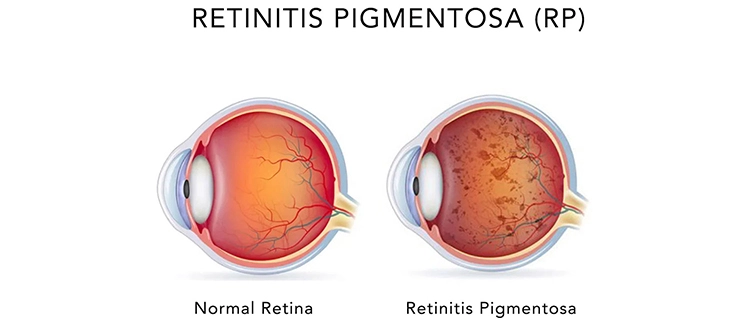
For many patients later diagnosed with retinitis pigmentosa (RP), the earliest signs were dismissed for years – attributed to tiredness, poor lighting, or simply “always being a bit clumsy in the dark.” Recognising these early warning signs matters, because earlier diagnosis allows for better monitoring and more informed decisions. Here’s what to actually watch for.
Why Night Blindness Comes First
RP typically affects rod photoreceptors – the cells responsible for vision in low light – before it affects cone cells, which handle central and colour vision. This is why night blindness, medically known as nyctalopia, is usually the earliest symptom, often appearing years, sometimes decades, before other changes become noticeable. Patients often describe struggling to adjust when moving from a bright room into a dim one, or finding it increasingly difficult to navigate at dusk or in dimly lit spaces like theatres or restaurants.
How Tunnel Vision Develops
As RP progresses, the loss of peripheral rod cells gradually narrows the field of vision, a pattern often described as “tunnel vision.” This tends to happen slowly, over years, which means patients frequently adapt without fully realising how much their visual field has changed – until something like missing objects to the side, bumping into furniture, or struggling in crowded spaces makes the change harder to ignore.
Why These Signs Are Often Missed
Because both night blindness and peripheral vision loss develop gradually, they are easy to rationalise away. A person might blame poor lighting, assume they’re simply less coordinated than others, or not realise that what feels normal to them is actually a narrowed field of vision compared to their peers. This is especially true in children, where symptoms may show up as reluctance to play in dim settings or unusual caution when moving around unfamiliar spaces, rather than a clear verbal complaint.
Other Early Signs Worth Noting
- Slower adaptation time when lighting changes suddenly
- Increasing difficulty with mobility in dim or unfamiliar environments
- A family history of RP or unexplained vision changes, even without a formal diagnosis
- Difficulty with tasks like driving at night, well before daytime vision is affected
Why Early Recognition Matters
RP is typically slow-progressing, which means an early, accurate diagnosis gives patients time to plan – for genetic counselling, for family screening, for regular monitoring of progression, and for exploring supportive or emerging treatment options relevant to their specific genetic subtype. Waiting until vision loss is advanced narrows the options available and the time to act on them.
Questions Worth Asking Your Doctor
- Could my difficulty with night vision or peripheral awareness be an early sign of an inherited retinal condition?
- What tests can confirm or rule out RP at an early stage?
- Should family members be screened, even without symptoms?
- What monitoring schedule is appropriate if early signs are confirmed?
What This Means in Practice
If night blindness or narrowing peripheral vision sounds familiar – for yourself or a family member – the most useful next step is a comprehensive eye examination that includes an electroretinogram (ERG) and visual field testing, rather than waiting to see if things “get worse first.” Early confirmation, even of a slow-progressing condition, gives patients meaningfully more time and more options.
Government & Regulatory References
- National Policy for Rare Diseases, 2021 – Ministry of Health and Family Welfare, Government of India – retinitis pigmentosa is classified as a rare inherited retinal disorder, and this policy outlines India’s framework for early diagnosis, genetic counselling, and management support for such conditions.
- Evidence-Based Status of Stem Cell Therapy for Human Diseases – Indian Council of Medical Research (ICMR)

Sorry, the comment form is closed at this time.