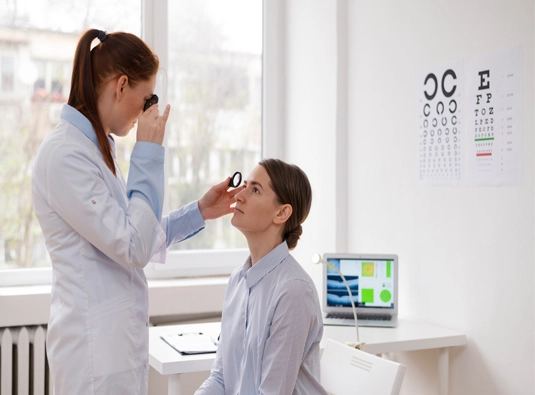
Among the inherited retinal dystrophies, Leber Congenital Amaurosis, or LCA, tends to be the most severe — causing profound vision impairment from birth or within the first several months of life. It ranks among the most commonly identified causes of inherited infant blindness, and understandably, a diagnosis brings an urgent wave of questions from Nigerian parents about its cause and what can be done straight away.
Because LCA presents so early, the evaluation process differs considerably from adult-onset retinal dystrophies. The priority becomes confirming the diagnosis quickly, identifying the responsible gene wherever possible, and starting appropriate support for the child’s vision and development without unnecessary delay.
10+
years Experience
years Experience
5000+
Patients treated
Patients treated
100+
Countries served
Countries served
NABH
Guided facility
Guided facility
Symptoms of Alstrom Syndrome (Ocular)
Within the first weeks to months, parents commonly notice poor visual fixation and tracking, wandering or roving eye movements known as nystagmus, and heightened sensitivity to light. A behaviour called the oculodigital sign — pressing, poking, or rubbing at the eyes — is common, believed to be the child’s own way of generating visual stimulation. Marked far-sightedness also frequently appears on refraction testing.
Causes of Alstrom Syndrome
More than two dozen genes have been linked to LCA, with GUCY2D, RPE65, and CEP290 among the most commonly implicated, and most cases follow an autosomal recessive pattern. The specific gene responsible matters significantly — it can influence the pattern of associated findings and, in certain cases, determine eligibility for gene-specific interventions.
Diagnosis for Nigerian Patients
In infants with LCA, electroretinography typically shows a severely diminished or entirely absent response — a finding that is central to distinguishing LCA from other causes of poor infant vision, such as delayed visual maturation. Genetic testing is strongly recommended as early as it can be arranged, with particular attention to RPE65-related mutations, since identifying the exact gene shapes both the prognosis discussion and future treatment eligibility.
Meet The Team
Our Eye Specialists

Dr. Pawan
Associate Professor, Vitreo-Retina Surgeon. 10+ Years Experience
Retinal disorders, diabetic retinopathy, and advanced retina procedures. Provides diagnostic evaluation and treatment planning for international patients.

Dr.Pallavi
Senior Consultant Ophthalmologist & Eye Surgeon· 26+ yrs experience
Areas of Focus: Cataract surgery, corneal disorders, refractive procedures, and glaucoma management. Provides comprehensive eye care and surgical expertise for global patients.
Dr. Robin
Consultant Ophthalmologist & Eye Surgeon, MD, DO .16+ Years Experience
Areas of Focus: Cataract surgery, corneal disorders, refractive procedures, and glaucoma management. Provides comprehensive eye care and surgical expertise for global patients.
Treatment Approach in India
Given how early and severely LCA presents, our approach combines a retinal evaluation — including consideration of regenerative stem cell therapy where testing supports it — with timely low-vision and developmental support suited to a young child, since early intervention can genuinely influence a child’s broader development. Families are guided through what to expect at each stage as the child grows.
Reviews
What Our Patients Say

DR NAAGALAKSHMI R
2 months ago

Asha Babbar
2 months ago
The overall experience at the RP Treatment Center was very good. The staff was supportive and caring, and we provided proper attention and guidance during treatment. The environment at the center was clean and comfortable. The doctors and staff tried to understand patients' needs and explained the treatment process well.
Overall, I am satisfied with the service and care. Highly recommended!
Overall, I am satisfied with the service and care. Highly recommended!

Harshita Kapoor
2 months ago
Life‑Changing Experience with RP Therapy”
After years of struggling with vision loss due to Retinitis Pigmentosa, I finally found hope here. The doctors were highly professional, explained the stem cell treatment in detail, and gave me confidence at every step. The therapy was smooth, and I’ve already noticed positive changes in my daily life. Their dedication, care, and advanced medical approach make this center truly trustworthy
After years of struggling with vision loss due to Retinitis Pigmentosa, I finally found hope here. The doctors were highly professional, explained the stem cell treatment in detail, and gave me confidence at every step. The therapy was smooth, and I’ve already noticed positive changes in my daily life. Their dedication, care, and advanced medical approach make this center truly trustworthy

Yash Chauhan
2 months ago
I had a really good experience at RP Treatment Centre. The doctor listened to my problem patiently and explained the treatment in a simple way. The staff was polite and the clinic was clean. I started feeling better after the treatment. Highly recommended!

pragya chauhan
2 months ago
Very satisfied with the service. The doctor is experienced and gives proper attention to every patient. The staff is friendly, and the overall environment is comfortable. Thank you, RP Treatment Centre, for the excellent care.

Manisha kapoor
2 months ago
I had been struggling with Retinitis Pigmentosa for years, and finding this center was truly life‑changing. The doctors provided a thorough medical evaluation and explained every step of the stem cell therapy process with clarity. The treatment was smooth, professional, and I noticed encouraging improvements in my vision within weeks. Their continuous follow‑up care and compassionate support made me feel confident throughout the journey. Highly recommended for anyone seeking advanced RP treatment in India.
Frequently Asked Questions
Does an LCA diagnosis mean my child has no vision at all?
“Not necessarily — the extent of vision affected varies by the specific gene and by the individual child, and some children retain limited but genuinely useful light perception, or even some form vision. A full evaluation is needed to determine exactly what level of function is present in each case.”
How soon should our child be evaluated?
”
As soon as poor visual behaviour is noticed. Earlier evaluation allows genetic testing to happen sooner — particularly important for identifying RPE65-related cases — and allows developmental support to begin without unnecessary delay.”
The diagnosis already seems clear — is genetic testing still necessary?
“Yes. Since LCA can arise from more than twenty different genes, knowing which one is responsible affects the outlook and may matter for eligibility for gene-specific treatments already available or in development, particularly for RPE65-related cases.”
Will our child be able to attend a mainstream school?
“That depends largely on how much vision remains and how early developmental and low-vision support begins. Many children with LCA do well with early intervention, and we are glad to discuss what that could look like for your child specifically.”