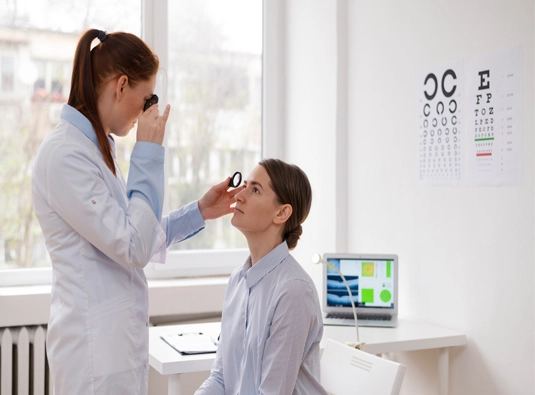
The retina depends on two kinds of light-sensing cells working in tandem — rods, which handle dim-light vision, and cones, which handle daylight and colour. Retinitis Pigmentosa begins when the rod population starts to fail, and from there follows a fairly recognisable trajectory, even though how fast that trajectory moves can differ enormously between individuals. It is the most common inherited retinal disorder seen in ophthalmology clinics across India, which is part of why the diagnosis, once raised, tends to prompt an immediate string of questions from patients and families alike.
Because RP can present at very different stages by the time someone reaches a retina specialist — some patients arrive having noticed night-time difficulty for years, others only after their field of vision has visibly narrowed — the first order of business is always establishing exactly where a given patient’s disease currently stands. Everything discussed afterward tends to follow from that assessment.
10+
years Experience
years Experience
5000+
Patients treated
Patients treated
100+
Countries served
Countries served
NABH
Guided facility
Guided facility
Ocular Symptoms
Trouble adjusting to low light is usually what brings patients in first — difficulty navigating a dim room, or driving once the sun goes down, sometimes noticed well before anything else changes. From there, the visual field begins contracting from its outer edges inward, producing the tunnel vision commonly associated with RP, occasionally preceded by a ring-shaped patch of loss somewhere in the mid-periphery. Central vision, which depends on the cones, typically stays functional for considerably longer, though in more advanced disease it too can eventually be drawn in.
Underlying Causes
RP isn’t traced to a single gene — more than 80 have been identified, with RHO, USH2A, and RPGR turning up most consistently in Indian cohorts as well as globally. The gene involved shapes how the condition is passed down: some families see it inherited as a dominant trait, others as recessive, and a subset follow an X-linked pattern. In families where more than one member is affected, working out that inheritance pattern is often just as informative as the clinical exam itself.
Diagnostic Evaluation
Confirming and staging RP typically draws on four key investigations: full-field electroretinography to record the retina’s electrical response, OCT imaging to assess the surviving photoreceptor layers, Goldmann visual field testing to chart exactly how far peripheral vision has receded, and fundus autofluorescence to outline the boundary between healthy and degenerating retinal tissue. Genetic testing, increasingly accessible in India, is recommended wherever possible, since the specific gene involved can meaningfully shape the outlook and the treatments worth considering.
Meet The Team
Our Eye Specialists

Dr. Pawan
Associate Professor, Vitreo-Retina Surgeon. 10+ Years Experience
Retinal disorders, diabetic retinopathy, and advanced retina procedures. Provides diagnostic evaluation and treatment planning for international patients.

Dr.Pallavi
Senior Consultant Ophthalmologist & Eye Surgeon· 26+ yrs experience
Areas of Focus: Cataract surgery, corneal disorders, refractive procedures, and glaucoma management. Provides comprehensive eye care and surgical expertise for global patients.
Dr. Robin
Consultant Ophthalmologist & Eye Surgeon, MD, DO .16+ Years Experience
Areas of Focus: Cataract surgery, corneal disorders, refractive procedures, and glaucoma management. Provides comprehensive eye care and surgical expertise for global patients.
Treatment Approach in India
For patients whose evaluation supports it, regenerative stem cell therapy is considered as part of a broader retinal-preservation plan, layered together with low-vision rehabilitation, guidance on adaptive lighting and safer mobility, and dietary counselling — so that treatment isn’t a single isolated event, but an ongoing plan the patient can carry forward.
Reviews
What Our Patients Say

DR NAAGALAKSHMI R
2 months ago

Asha Babbar
2 months ago
The overall experience at the RP Treatment Center was very good. The staff was supportive and caring, and we provided proper attention and guidance during treatment. The environment at the center was clean and comfortable. The doctors and staff tried to understand patients' needs and explained the treatment process well.
Overall, I am satisfied with the service and care. Highly recommended!
Overall, I am satisfied with the service and care. Highly recommended!

Harshita Kapoor
2 months ago
Life‑Changing Experience with RP Therapy”
After years of struggling with vision loss due to Retinitis Pigmentosa, I finally found hope here. The doctors were highly professional, explained the stem cell treatment in detail, and gave me confidence at every step. The therapy was smooth, and I’ve already noticed positive changes in my daily life. Their dedication, care, and advanced medical approach make this center truly trustworthy
After years of struggling with vision loss due to Retinitis Pigmentosa, I finally found hope here. The doctors were highly professional, explained the stem cell treatment in detail, and gave me confidence at every step. The therapy was smooth, and I’ve already noticed positive changes in my daily life. Their dedication, care, and advanced medical approach make this center truly trustworthy

Yash Chauhan
2 months ago
I had a really good experience at RP Treatment Centre. The doctor listened to my problem patiently and explained the treatment in a simple way. The staff was polite and the clinic was clean. I started feeling better after the treatment. Highly recommended!

pragya chauhan
2 months ago
Very satisfied with the service. The doctor is experienced and gives proper attention to every patient. The staff is friendly, and the overall environment is comfortable. Thank you, RP Treatment Centre, for the excellent care.

Manisha kapoor
2 months ago
I had been struggling with Retinitis Pigmentosa for years, and finding this center was truly life‑changing. The doctors provided a thorough medical evaluation and explained every step of the stem cell therapy process with clarity. The treatment was smooth, professional, and I noticed encouraging improvements in my vision within weeks. Their continuous follow‑up care and compassionate support made me feel confident throughout the journey. Highly recommended for anyone seeking advanced RP treatment in India.
Frequently Asked Questions
Will RP eventually take away all my vision?
” Not necessarily. How the disease unfolds varies substantially from person to person, shaped largely by which gene is responsible and how it’s inherited. A good number of people with RP retain functional vision, particularly centrally, well into later life — which is precisely why every case gets assessed on its own merits rather than assumed to follow one script.
”
Two of my children already show early signs — should we worry about the rest?
”
That comes down to the inheritance pattern tied to the responsible gene, and genetic testing is the surest way to find that out. We can talk you through what it’s likely to mean for your family, and for decisions around future children, we’d also suggest consulting a certified genetic counsellor.”
My local optician said my eyes look fine — could it still be RP?
” Very possibly, yes. A routine refraction check is designed to catch things like short-sightedness or cataract, not RP — the equipment needed to properly diagnose and stage it, such as ERG and detailed field testing, is only available at specialised retina centres, which is why a dedicated referral is usually the next step.”
What should I bring to my first appointment at a retina clinic?
“Any prior eye reports or prescriptions you have, a sense of whether anyone else in the family has had similar vision trouble, and a rough timeline of when your own symptoms began and how they’ve changed. That background alone often speeds up the diagnostic process considerably.”