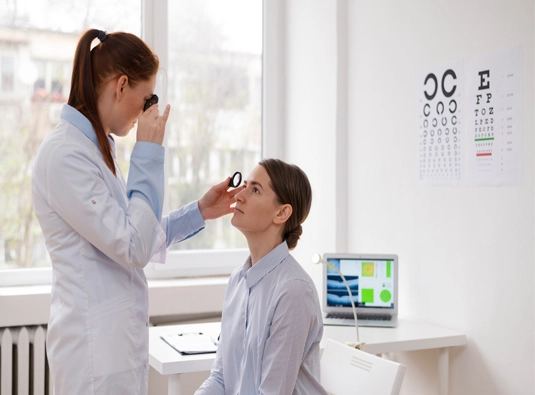
Wolfram Syndrome is also known by the acronym DIDMOAD, built from its four hallmark features — Diabetes Insipidus, Diabetes Mellitus, Optic Atrophy, and Deafness. What distinguishes it from most of the conditions discussed here is the location of the underlying eye problem: it originates not in the rod and cone photoreceptors, but in the optic nerve itself, the pathway that carries visual signals from the eye to the brain, which gradually deteriorates.
Zimbabwean families typically approach us about the eye component after diabetes mellitus has already been diagnosed and is under an endocrinologist’s care, with emerging vision changes prompting referral to confirm optic atrophy and assess how far it has advanced.
10+
years Experience
years Experience
5000+
Patients treated
Patients treated
100+
Countries served
Countries served
NABH
Guided facility
Guided facility
Ocular Symptoms
Colour perception and contrast sensitivity are usually the earliest casualties, followed by a steady, gradual decline in central visual sharpness as the optic nerve deteriorates — a pattern distinctly different from the peripheral vision loss seen in rod-cone conditions. Since Wolfram Syndrome is a whole-body disease, eye symptoms often appear together with, or after, early-onset diabetes mellitus, progressive hearing loss, and sometimes diabetes insipidus with associated urinary complications.
Underlying Causes
Most cases stem from mutations in the WFS1 gene, which codes for a protein called wolframin that helps cells manage stress within the endoplasmic reticulum. When this stress-response system breaks down, tissues with especially demanding metabolic needs — the optic nerve, the insulin-producing cells of the pancreas, and the inner ear — become particularly vulnerable to progressive damage.
Diagnosis for Zimbabwean Patients
Since the disease process centres on the optic nerve rather than the photoreceptor layer, our evaluation leans heavily on OCT imaging of the optic nerve fibre layer to document thinning, combined with visual field testing and colour vision assessment. WFS1 genetic testing supports the diagnosis, and we review the patient’s existing endocrinology and audiology records from Zimbabwe to build a complete picture of how the condition is affecting different organ systems.
Meet The Team
Our Eye Specialists

Dr. Pawan
Associate Professor, Vitreo-Retina Surgeon. 10+ Years Experience
Retinal disorders, diabetic retinopathy, and advanced retina procedures. Provides diagnostic evaluation and treatment planning for international patients.

Dr.Pallavi
Senior Consultant Ophthalmologist & Eye Surgeon· 26+ yrs experience
Areas of Focus: Cataract surgery, corneal disorders, refractive procedures, and glaucoma management. Provides comprehensive eye care and surgical expertise for global patients.
Dr. Robin
Consultant Ophthalmologist & Eye Surgeon, MD, DO .16+ Years Experience
Areas of Focus: Cataract surgery, corneal disorders, refractive procedures, and glaucoma management. Provides comprehensive eye care and surgical expertise for global patients.
Treatment Approach in India
Because optic atrophy in Wolfram Syndrome follows a very different course from photoreceptor-based dystrophies, our retinal team’s role is centred on careful, ongoing monitoring of optic nerve function alongside supportive low-vision planning, with any consideration of regenerative treatment weighed specifically against optic nerve findings and discussed openly in terms of what is realistically achievable given how distinct this disease process is.
Reviews
What Our Patients Say

DR NAAGALAKSHMI R
2 months ago

Asha Babbar
2 months ago
The overall experience at the RP Treatment Center was very good. The staff was supportive and caring, and we provided proper attention and guidance during treatment. The environment at the center was clean and comfortable. The doctors and staff tried to understand patients' needs and explained the treatment process well.
Overall, I am satisfied with the service and care. Highly recommended!
Overall, I am satisfied with the service and care. Highly recommended!

Harshita Kapoor
2 months ago
Life‑Changing Experience with RP Therapy”
After years of struggling with vision loss due to Retinitis Pigmentosa, I finally found hope here. The doctors were highly professional, explained the stem cell treatment in detail, and gave me confidence at every step. The therapy was smooth, and I’ve already noticed positive changes in my daily life. Their dedication, care, and advanced medical approach make this center truly trustworthy
After years of struggling with vision loss due to Retinitis Pigmentosa, I finally found hope here. The doctors were highly professional, explained the stem cell treatment in detail, and gave me confidence at every step. The therapy was smooth, and I’ve already noticed positive changes in my daily life. Their dedication, care, and advanced medical approach make this center truly trustworthy

Yash Chauhan
2 months ago
I had a really good experience at RP Treatment Centre. The doctor listened to my problem patiently and explained the treatment in a simple way. The staff was polite and the clinic was clean. I started feeling better after the treatment. Highly recommended!

pragya chauhan
2 months ago
Very satisfied with the service. The doctor is experienced and gives proper attention to every patient. The staff is friendly, and the overall environment is comfortable. Thank you, RP Treatment Centre, for the excellent care.

Manisha kapoor
2 months ago
I had been struggling with Retinitis Pigmentosa for years, and finding this center was truly life‑changing. The doctors provided a thorough medical evaluation and explained every step of the stem cell therapy process with clarity. The treatment was smooth, professional, and I noticed encouraging improvements in my vision within weeks. Their continuous follow‑up care and compassionate support made me feel confident throughout the journey. Highly recommended for anyone seeking advanced RP treatment in India.
Frequently Asked Questions
Is Wolfram Syndrome related to retinitis pigmentosa in any way?
“Not really — both lead to progressive vision loss, but Wolfram Syndrome operates through the optic nerve rather than the rod and cone photoreceptors affected in retinitis pigmentosa. That difference changes both the pattern of vision loss and how we go about evaluating it.”
A family member with diabetes is now losing their vision — could this be Wolfram Syndrome?
”
It’s worth flagging to a specialist, particularly if the diabetes began young and hearing changes have also appeared, though confirming it requires OCT imaging of the optic nerve alongside genetic testing, since several other conditions can also cause vision loss in someone with diabetes.”
Will your team also manage the diabetes or hearing loss associated with this condition?
“Our role stays focused specifically on the optic nerve and visual aspects. Diabetes and hearing loss remain the responsibility of endocrinology and audiology specialists, and we tailor our recommendations to fit alongside whatever care is already underway there.”
How does the speed of vision loss in Wolfram Syndrome compare with the other conditions you manage?
“It varies from person to person, but optic atrophy here generally advances steadily over a period of years. Because the disease mechanism differs from rod-cone or cone-rod dystrophies, we monitor it using optic-nerve-specific measurements rather than the field and night-vision testing used for photoreceptor-based conditions.”