
08 Aug Retinitis Pigmentosa Explained: Causes, Genetics & Early Symptoms
Medically reviewed by Dr. Prashant Tyagi (Stem Cell Biotechnology Specialist, 10+ years) and Dr. Pallavee Senior Consultant | Ophthalmologist & Eye Surgeon 22+ Years Experience
Retinitis pigmentosa (RP) is one of the most common inherited retinal conditions, yet many patients receive the diagnosis with very little explanation of what it actually means for their vision, their family, or their future options. Here’s a clear, honest look at the condition based on the questions we hear most often from newly diagnosed patients and their families.
What Retinitis Pigmentosa Actually Is
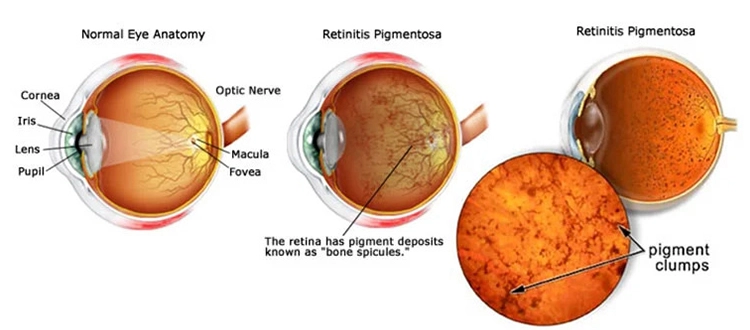
Retinitis pigmentosa is not a single disease but a group of inherited conditions that cause the progressive breakdown of photoreceptor cells in the retina — the rods and cones responsible for detecting light and colour. Rods, which are responsible for night and peripheral vision, are typically affected first, which is why night blindness is often the earliest noticeable symptom, sometimes years before central vision is affected at all.
The Genetics Behind RP
RP can be inherited in several different patterns:
– Autosomal recessive the most common pattern, requiring a mutated gene copy from both parents
– Autosomal dominant a single mutated gene copy from one parent is sufficient
– X-linked generally affecting males more severely, carried on the X chromosome
– Sporadic occurring with no clear family history, sometimes due to a new genetic mutation
More than 80 genes have been associated with RP, which is part of why the condition varies so much in its rate of progression and severity between patients even within the same family. Genetic testing has become an increasingly important tool, both for confirming a diagnosis and for understanding inheritance risk for other family members.
Early Symptoms to Watch For
– **Night blindness difficulty seeing in low light, often the first noticeable sign
– **Peripheral vision loss a gradually narrowing field of vision, sometimes described as “tunnel vision” in later stages
– **Slow adaptation to lighting changes such as moving from a bright room to a dim one
– **Difficulty with mobility in dim environments even before formal vision testing shows clear changes
Because RP typically progresses slowly over years or decades, many patients adapt unconsciously to early symptoms and don’t seek evaluation until vision loss has become more noticeable.
How RP Is Diagnosed
Diagnosis generally involves a detailed eye examination looking for characteristic pigment changes in the retina, an electroretinogram (ERG) to measure how well the rods and cones are functioning, visual field testing to map peripheral vision loss, and optical coherence tomography (OCT) to assess retinal structure. Genetic testing is increasingly recommended alongside these, both to confirm the specific type of RP and to inform family counselling.
Questions Worth Asking Your Doctor
– Has genetic testing identified the specific gene involved in my case, and what does that suggest about progression?
– What is the realistic rate of progression for my specific type of RP?
– Should other family members be tested or evaluated?
– What monitoring schedule is appropriate for tracking changes over time?
What This Means in Practice
Because RP is a progressive condition with no universally established cure, most care plans focus on three things: confirming an accurate genetic diagnosis, establishing a regular monitoring schedule to track changes, and discussing supportive or emerging treatment options including regenerative approaches appropriate to the specific gene involved and the current stage of the condition. An early, thorough diagnosis gives patients the clearest possible picture of what to expect and what options may be relevant to their specific case.
Government & Regulatory References
Related Reading
Stem Cell Therapy for Eye Disease in India

Pingback:RP Diagnosis: Electroretinogram (ERG) and Genetic Testing Explained
Posted at 07:11h, 25 August[…] Retinitis Pigmentosa Explained: Causes, Genetics & Early Symptoms […]
Pingback:Latest Global Clinical Trials for Retinitis Pigmentosa (2026 Update)
Posted at 13:07h, 01 September[…] Retinitis Pigmentosa Explained: Causes, Genetics & Early Symptoms […]
Pingback:Understanding RP Progression: Stages from Early to Advanced Disease Treatment
Posted at 07:52h, 08 September[…] Retinitis Pigmentosa Explained: Causes, Genetics & Early Symptoms […]