Retinitis Pigmentosa (RP) is not one single illness but a broad group of inherited retinal disorders that all share a common endpoint: the slow, progressive loss of the rod and cone photoreceptor cells lining the retina. It ranks as the most commonly diagnosed inherited retinal disease anywhere in the world, and Ghanaian families who have just received an RP diagnosis usually want two things clarified first — what the disease means for everyday vision, and what options genuinely exist to slow it down.
Because RP tends to unfold gradually over years, the clinical team’s first priority is pinpointing exactly how far a patient has progressed along the disease timeline before any treatment plan is even discussed. That individual staging, rather than a generic protocol applied to everyone, is what ultimately guides the recommendations given to a Ghanaian patient once they arrive in India for evaluation.
10+
years Experience
years Experience
5000+
Patients treated
Patients treated
100+
Countries served
Countries served
NABH
Guided facility
Guided facility
Ocular Symptoms
Rod photoreceptors, which govern vision in dim conditions, tend to fail first, so many patients first notice trouble seeing at dusk or inside dimly lit rooms. As the condition progresses, the field of vision shrinks inward from the edges, giving rise to the familiar ‘tunnel vision’ effect; a ring-shaped area of vision loss, known as a ring scotoma, commonly develops partway through the disease. Fine, central vision is usually the last to be affected, although it can eventually decline once cone cells become involved in later stages.
Underlying Causes
RP is considered the most genetically varied eye disease currently known, with more than 80 distinct genes — among them RHO, USH2A, and RPGR — linked to its various forms. Depending on which gene is responsible, the condition may be passed down in an autosomal dominant, autosomal recessive, or X-linked manner, which is exactly why tracing family history and building a pedigree chart plays such an important role when counselling a Ghanaian household with more than one affected member.
Diagnosis for Ghanaian Patients
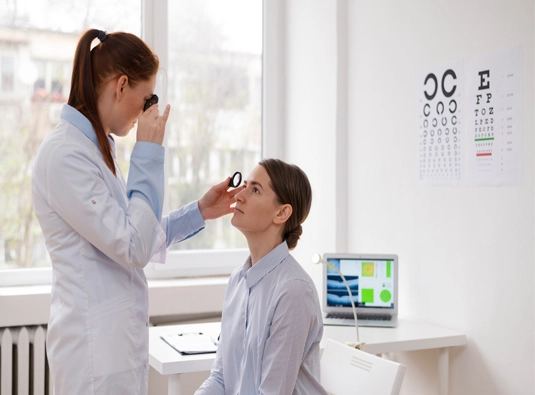
Establishing an RP diagnosis and charting its progression relies on a cluster of specialised tests: full-field electroretinography (ERG) to record how the rods and cones respond electrically, optical coherence tomography (OCT) to examine the photoreceptor layers that remain intact, Goldmann visual field testing to map how much peripheral vision has been lost, and fundus autofluorescence imaging to show the boundary between healthy retina and the areas already affected. Where practical, genetic testing is also offered, since knowing the specific gene involved can shape both the long-term outlook and eligibility for newer gene-targeted therapies.
Meet The Team
Our Eye Specialists

Dr. Pawan
Associate Professor, Vitreo-Retina Surgeon. 10+ Years Experience
Retinal disorders, diabetic retinopathy, and advanced retina procedures. Provides diagnostic evaluation and treatment planning for international patients.

Dr.Pallavi
Senior Consultant Ophthalmologist & Eye Surgeon· 26+ yrs experience
Areas of Focus: Cataract surgery, corneal disorders, refractive procedures, and glaucoma management. Provides comprehensive eye care and surgical expertise for global patients.
Dr. Robin
Consultant Ophthalmologist & Eye Surgeon, MD, DO .16+ Years Experience
Areas of Focus: Cataract surgery, corneal disorders, refractive procedures, and glaucoma management. Provides comprehensive eye care and surgical expertise for global patients.
Treatment Approach in India
For patients whose evaluation supports it, regenerative stem cell therapy is offered as one part of a wider strategy aimed at preserving whatever retinal tissue is still functioning. This is combined with low-vision rehabilitation techniques, practical advice on lighting and safe mobility, and dietary counselling — all brought together so the patient heads back to Ghana with a coherent, long-term management plan rather than a single standalone procedure.
Reviews
What Our Patients Say

DR NAAGALAKSHMI R
2 months ago

Asha Babbar
2 months ago
The overall experience at the RP Treatment Center was very good. The staff was supportive and caring, and we provided proper attention and guidance during treatment. The environment at the center was clean and comfortable. The doctors and staff tried to understand patients' needs and explained the treatment process well.
Overall, I am satisfied with the service and care. Highly recommended!
Overall, I am satisfied with the service and care. Highly recommended!

Harshita Kapoor
2 months ago
Life‑Changing Experience with RP Therapy”
After years of struggling with vision loss due to Retinitis Pigmentosa, I finally found hope here. The doctors were highly professional, explained the stem cell treatment in detail, and gave me confidence at every step. The therapy was smooth, and I’ve already noticed positive changes in my daily life. Their dedication, care, and advanced medical approach make this center truly trustworthy
After years of struggling with vision loss due to Retinitis Pigmentosa, I finally found hope here. The doctors were highly professional, explained the stem cell treatment in detail, and gave me confidence at every step. The therapy was smooth, and I’ve already noticed positive changes in my daily life. Their dedication, care, and advanced medical approach make this center truly trustworthy

Yash Chauhan
2 months ago
I had a really good experience at RP Treatment Centre. The doctor listened to my problem patiently and explained the treatment in a simple way. The staff was polite and the clinic was clean. I started feeling better after the treatment. Highly recommended!

pragya chauhan
2 months ago
Very satisfied with the service. The doctor is experienced and gives proper attention to every patient. The staff is friendly, and the overall environment is comfortable. Thank you, RP Treatment Centre, for the excellent care.

Manisha kapoor
2 months ago
I had been struggling with Retinitis Pigmentosa for years, and finding this center was truly life‑changing. The doctors provided a thorough medical evaluation and explained every step of the stem cell therapy process with clarity. The treatment was smooth, professional, and I noticed encouraging improvements in my vision within weeks. Their continuous follow‑up care and compassionate support made me feel confident throughout the journey. Highly recommended for anyone seeking advanced RP treatment in India.
Frequently Asked Questions
Does everyone diagnosed with RP end up completely blind?
“No. How much vision is eventually lost, and how quickly, differs enormously from person to person depending on the gene involved and how it is inherited. A great many people with RP keep some functional vision, especially central vision, well into old age, which is why each case needs individual assessment rather than being judged by the diagnosis label alone.”
Two of my children already have RP — could my other children develop it later?
”
That depends entirely on how the specific gene responsible is inherited, and genetic testing can help clarify this. Our team is able to explain what your family’s particular inheritance pattern suggests, though formal genetic counselling around future family planning is best handled together with a certified genetic counsellor.”
How is an RP work-up different from a normal eye check-up in Ghana?
“A standard eye check-up looks mainly for common problems such as refractive error or cataract. Evaluating RP calls for equipment most local clinics simply don’t carry — particularly ERG and detailed peripheral field mapping — which is exactly why many families choose to travel for a dedicated, specialist assessment.”
What should I carry with me from Ghana for the first appointment?
“Bring along any eye reports you already have, a note of which family members are affected if that’s known, and a clear account of when symptoms first appeared and how they’ve changed since. This history alone can significantly speed up the diagnostic process.”