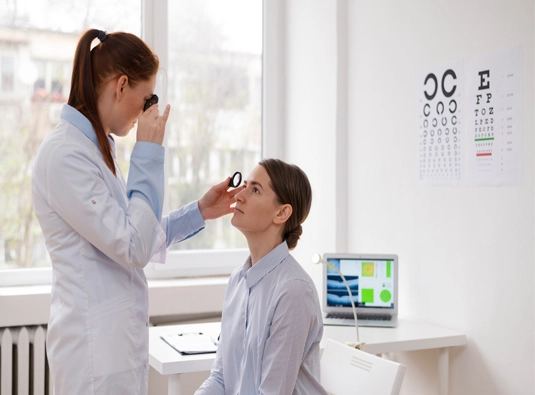
Vision built for daylight and vision built for darkness rely on two different types of retinal cell, and retinitis pigmentosa is what happens when one of those cell populations begins failing years, sometimes decades, before the other. It is the most frequently diagnosed inherited cause of progressive vision loss anywhere in the world, and for patients across Mexico it is often the term a local ophthalmologist first mentions after a routine exam turns up something unexpected.
No two patients follow quite the same timeline, so before anything else is discussed, an evaluation has to establish where a given patient actually sits within that progression. Everything that follows in the consultation — what to expect, what to test for, what to do next — depends on getting that starting point right.
10+
years Experience
years Experience
5000+
Patients treated
Patients treated
100+
Countries served
Countries served
NABH
Guided facility
Guided facility
Ocular Symptoms
Rod cells are usually the first casualty, so difficulty seeing in low light — a dim restaurant, a poorly lit street — tends to be the earliest complaint, frequently noticed well before any formal diagnosis. As the disease advances, the visual field narrows steadily inward from the periphery, producing the tunnel-like vision RP is best known for, sometimes with a ring-shaped blind spot appearing partway through that process. Central, cone-driven vision is typically the most resilient, though resilient is not the same as permanent, and it too can decline once the disease reaches a later stage.
Underlying Causes
RP is not caused by one gene but by more than eighty identified so far, with RHO, USH2A, and RPGR turning up most often in clinical practice. Depending on which gene is responsible, the condition can pass through a family as a dominant, a recessive, or an X-linked trait, and working out which pattern applies in a specific Mexican family often tells us nearly as much as the retinal exam itself.
Diagnosis for Mexican Patients
Four investigations carry most of the diagnostic weight: full-field electroretinography, which measures the electrical signal produced by rods and cones; OCT, which images how much of the photoreceptor layer remains; Goldmann visual field testing, which maps exactly how far peripheral vision has narrowed; and fundus autofluorescence, which highlights the border between healthy and degenerating retina. Genetic testing is offered wherever practical, since the specific gene at fault can shift both the expected course of the disease and which treatment paths are worth pursuing.
Meet The Team
Our Eye Specialists

Dr. Pawan
Associate Professor, Vitreo-Retina Surgeon. 10+ Years Experience
Retinal disorders, diabetic retinopathy, and advanced retina procedures. Provides diagnostic evaluation and treatment planning for international patients.

Dr.Pallavee
Senior Consultant Ophthalmologist & Eye Surgeon· 26+ yrs experience
Areas of Focus: Cataract surgery, corneal disorders, refractive procedures, and glaucoma management. Provides comprehensive eye care and surgical expertise for global patients.
Dr. Robin
Consultant Ophthalmologist & Eye Surgeon, MD, DO .16+ Years Experience
Areas of Focus: Cataract surgery, corneal disorders, refractive procedures, and glaucoma management. Provides comprehensive eye care and surgical expertise for global patients.
Treatment Approach in India
Where a patient’s test results support it, regenerative stem cell therapy is folded into a broader plan built around preserving whatever retinal function remains. That plan typically runs alongside low-vision rehabilitation, guidance on lighting and safe mobility, and nutritional advice, so that a patient travelling from Mexico leaves with an ongoing framework for managing the condition rather than a single isolated procedure.
Reviews
What Our Patients Say

DR NAAGALAKSHMI R
4 weeks ago

Asha Babbar
4 weeks ago
The overall experience at the RP Treatment Center was very good. The staff was supportive and caring, and we provided proper attention and guidance during treatment. The environment at the center was clean and comfortable. The doctors and staff tried to understand patients' needs and explained the treatment process well.
Overall, I am satisfied with the service and care. Highly recommended!
Overall, I am satisfied with the service and care. Highly recommended!

Harshita Kapoor
4 weeks ago
Life‑Changing Experience with RP Therapy”
After years of struggling with vision loss due to Retinitis Pigmentosa, I finally found hope here. The doctors were highly professional, explained the stem cell treatment in detail, and gave me confidence at every step. The therapy was smooth, and I’ve already noticed positive changes in my daily life. Their dedication, care, and advanced medical approach make this center truly trustworthy
After years of struggling with vision loss due to Retinitis Pigmentosa, I finally found hope here. The doctors were highly professional, explained the stem cell treatment in detail, and gave me confidence at every step. The therapy was smooth, and I’ve already noticed positive changes in my daily life. Their dedication, care, and advanced medical approach make this center truly trustworthy

Yash Chauhan
4 weeks ago
I had a really good experience at RP Treatment Centre. The doctor listened to my problem patiently and explained the treatment in a simple way. The staff was polite and the clinic was clean. I started feeling better after the treatment. Highly recommended!

pragya chauhan
4 weeks ago
Very satisfied with the service. The doctor is experienced and gives proper attention to every patient. The staff is friendly, and the overall environment is comfortable. Thank you, RP Treatment Centre, for the excellent care.

Manisha kapoor
4 weeks ago
I had been struggling with Retinitis Pigmentosa for years, and finding this center was truly life‑changing. The doctors provided a thorough medical evaluation and explained every step of the stem cell therapy process with clarity. The treatment was smooth, professional, and I noticed encouraging improvements in my vision within weeks. Their continuous follow‑up care and compassionate support made me feel confident throughout the journey. Highly recommended for anyone seeking advanced RP treatment in India.
Frequently Asked Questions
Will I eventually lose all of my sight because of RP?
“Not necessarily, and outcomes vary considerably from person to person, largely driven by which gene is responsible and how it is inherited. Many people with RP retain meaningful central vision well into later life. That variability is exactly why each case is assessed individually rather than treated as a single predictable disease.
”
More than one of my children already shows symptoms — should we be concerned about the rest?
”
That depends on the inheritance pattern of the specific gene involved, and genetic testing is the most reliable way to establish it. We can explain what the result likely means for your family, though for decisions about future children we would recommend involving a certified genetic counsellor alongside that conversation.”
Why can’t a routine eye exam in Mexico pick this up earlier?
“A standard eye exam is built to catch things like refractive error or cataract, not a slowly progressing retinal dystrophy. Confirming and staging RP needs equipment most general clinics do not stock — electroretinography and detailed visual field mapping in particular — which is why a dedicated evaluation usually means travelling somewhere that equipment exists.”
What should we bring to a first appointment?
“Any eye reports already on file, a general sense of family history if RP has appeared before, and a timeline of when symptoms started and how they have changed since. That background alone speeds up the diagnostic process considerably.”