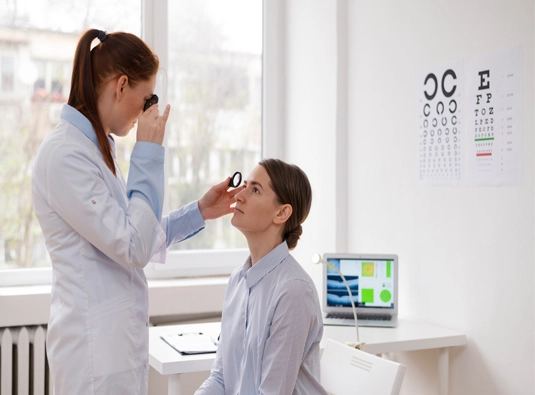
‘Night blindness’ reads like a diagnosis on paper, but it is really a symptom — and a fairly non-specific one, capable of pointing anywhere from a dietary shortfall to the first sign of a degenerating retina. For a patient in Uganda, working out which of those two it actually is matters a great deal, since the seriousness at either end of that range is worlds apart
That is why our first move is neither reassurance nor alarm — it is testing, focused entirely on placing a given patient’s symptom into the right category before any further conversation happens..
10+
years Experience
years Experience
5000+
Patients treated
Patients treated
100+
Countries served
Countries served
NABH
Guided facility
Guided facility
Ocular Symptoms
The complaint we hear most often is a slow adjustment when moving from a bright room into a dim one — patients describe struggling to make out faces once dusk sets in, or feeling unsteady walking or driving after dark. Sensitivity to oncoming headlights at night is another common report, frequently described as harsher than it used to feel.
Underlying Causes
Globally, vitamin A shortage remains the single leading cause of night blindness, and fortunately also the easiest to correct, typically confirmed through a straightforward blood test. Beyond nutrition, the same complaint can arise from congenital stationary night blindness, which stays static over time, from early-stage retinitis pigmentosa, which does not, or from a dense cataract or significant myopia interfering with peripheral vision. Each of these paths leads somewhere quite different, which is exactly why pinning down the cause matters just as much as treating the symptom.
Diagnosis for Ugandan Patients
Dark adaptometry measures, with real precision, how long the eyes need to regain sensitivity after bright-light exposure — often the single clearest way to distinguish a nutritional cause from a retinal one. We pair that with electroretinography to test rod function directly, a serum vitamin A level, and a careful history: a symptom that has stayed stable over time points away from progressive retinal disease, while one that keeps worsening points toward it.
Meet The Team
Our Eye Specialists

Dr. Pawan
Associate Professor, Vitreo-Retina Surgeon. 10+ Years Experience
Retinal disorders, diabetic retinopathy, and advanced retina procedures. Provides diagnostic evaluation and treatment planning for international patients.

Dr.Pallavi
Senior Consultant Ophthalmologist & Eye Surgeon· 26+ yrs experience
Areas of Focus: Cataract surgery, corneal disorders, refractive procedures, and glaucoma management. Provides comprehensive eye care and surgical expertise for global patients.
Dr. Robin
Consultant Ophthalmologist & Eye Surgeon, MD, DO .16+ Years Experience
Areas of Focus: Cataract surgery, corneal disorders, refractive procedures, and glaucoma management. Provides comprehensive eye care and surgical expertise for global patients.
Treatment Approach in India
When vitamin A deficiency turns out to be the cause, supplementation and dietary adjustment are usually all that is required, and we make sure families understand that clearly so nobody leaves assuming something more serious is at play. If testing instead confirms genuine retinal degeneration, management follows whichever dystrophy is behind it, with regenerative stem cell therapy entering the conversation only at that stage, as a supportive option.
Reviews
What Our Patients Say


DR NAAGALAKSHMI R
2 months ago

Asha Babbar
2 months ago
The overall experience at the RP Treatment Center was very good. The staff was supportive and caring, and we provided proper attention and guidance during treatment. The environment at the center was clean and comfortable. The doctors and staff tried to understand patients' needs and explained the treatment process well.
Overall, I am satisfied with the service and care. Highly recommended!
Overall, I am satisfied with the service and care. Highly recommended!

Harshita Kapoor
2 months ago
Life‑Changing Experience with RP Therapy”
After years of struggling with vision loss due to Retinitis Pigmentosa, I finally found hope here. The doctors were highly professional, explained the stem cell treatment in detail, and gave me confidence at every step. The therapy was smooth, and I’ve already noticed positive changes in my daily life. Their dedication, care, and advanced medical approach make this center truly trustworthy
After years of struggling with vision loss due to Retinitis Pigmentosa, I finally found hope here. The doctors were highly professional, explained the stem cell treatment in detail, and gave me confidence at every step. The therapy was smooth, and I’ve already noticed positive changes in my daily life. Their dedication, care, and advanced medical approach make this center truly trustworthy

Yash Chauhan
2 months ago
I had a really good experience at RP Treatment Centre. The doctor listened to my problem patiently and explained the treatment in a simple way. The staff was polite and the clinic was clean. I started feeling better after the treatment. Highly recommended!

pragya chauhan
2 months ago
Very satisfied with the service. The doctor is experienced and gives proper attention to every patient. The staff is friendly, and the overall environment is comfortable. Thank you, RP Treatment Centre, for the excellent care.

Manisha kapoor
2 months ago
I had been struggling with Retinitis Pigmentosa for years, and finding this center was truly life‑changing. The doctors provided a thorough medical evaluation and explained every step of the stem cell therapy process with clarity. The treatment was smooth, professional, and I noticed encouraging improvements in my vision within weeks. Their continuous follow‑up care and compassionate support made me feel confident throughout the journey. Highly recommended for anyone seeking advanced RP treatment in India.
Frequently Asked Questions
Does trouble seeing at night always signal something serious?
“No, not automatically. A large proportion of these cases, particularly where diet has been restricted, trace back to low vitamin A — something that generally responds well once corrected. Testing is what separates those simpler cases from ones that genuinely need closer retinal follow-up.”
If it turns out to be vitamin A deficiency, will my night vision recover?
“In most cases, yes — night vision typically improves once vitamin A levels are restored, provided the deficiency is identified and treated before any lasting retinal damage occurs.”
At what age should a child’s night-vision difficulty be evaluated?
”
There’s no age you need to wait past. If a child seems to struggle in dim light — bumping into furniture at dusk, for example — it’s worth having it checked promptly, since both nutritional and inherited causes respond better the earlier they are caught.”
Do we really need to travel abroad just to check a vitamin level?
“Not usually — a basic vitamin A blood test can typically be arranged locally within Uganda first. Travel becomes more relevant if that result is normal, or if the broader symptom pattern suggests an underlying retinal issue that needs imaging and electrophysiology testing unavailable locally.”