Two kinds of light-sensing cells share the retina between them: rods, tuned for dim conditions, and cones, tuned for bright light and colour. Retinitis Pigmentosa describes a breakdown that starts on the rod side of that partnership, and because it does, the resulting pattern of vision loss follows a fairly consistent script even though the timeline can stretch or compress dramatically from one patient to the next. It stands as the most common inherited cause of progressive vision loss anywhere in the world, which explains why the term keeps coming up once a Rwandan ophthalmologist first raises it with a family.
Every RP journey looks a little different depending on how far it has already travelled, so pinning down the current stage is where any serious treatment conversation has to start. That single piece of information — how much has already changed — tends to steer nearly everything that follows.
10+
years Experience
years Experience
5000+
Patients treated
Patients treated
100+
Countries served
Countries served
NABH
Guided facility
Guided facility
Ocular Symptoms
Since the rods go first, patients typically notice trouble seeing once the sun goes down, or inside dimly lit rooms, often years before anything else feels different. From there the field of vision starts closing in from the outer edges, the classic ‘tunnel vision’ associated with RP, sometimes preceded by a ring-shaped blind patch partway through that process. Central vision, driven by the cones, usually manages to hold out considerably longer — though it isn’t guaranteed to last forever, and can eventually be drawn into the decline once the disease has progressed far enough.
Underlying Causes
More than 80 different genes have been linked to RP, with RHO, USH2A, and RPGR standing out as the most commonly implicated. Which gene is at fault determines how the condition travels through a family tree — sometimes dominant, sometimes recessive, sometimes carried on the X chromosome. When a household in Rwanda has more than one affected member, tracing that inheritance pattern across the family can be nearly as informative as the eye exam itself.
Diagnosis for Rwandan Patients
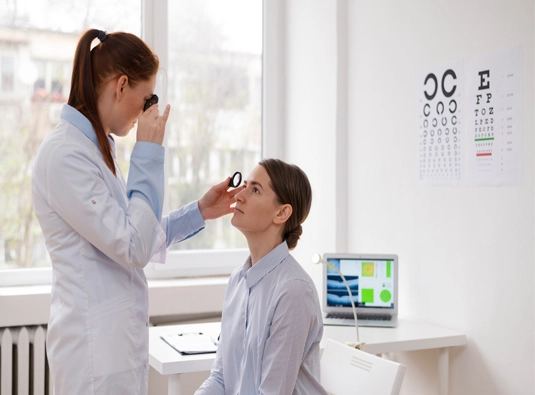
Four tests do most of the diagnostic heavy lifting: full-field electroretinography, which captures the electrical response generated by rods and cones; OCT scanning, which images the layers of surviving photoreceptor tissue; Goldmann visual field testing, which precisely maps how far the peripheral vision has retreated; and fundus autofluorescence, which traces the line between healthy retina and the areas already affected. Genetic testing is recommended wherever it can be arranged, since knowing the responsible gene often reshapes both the prognosis and which treatment paths are realistic.
Meet The Team
Our Eye Specialists

Dr. Pawan
Associate Professor, Vitreo-Retina Surgeon. 10+ Years Experience
Retinal disorders, diabetic retinopathy, and advanced retina procedures. Provides diagnostic evaluation and treatment planning for international patients.

Dr.Pallavee
Senior Consultant Ophthalmologist & Eye Surgeon· 26+ yrs experience
Areas of Focus: Cataract surgery, corneal disorders, refractive procedures, and glaucoma management. Provides comprehensive eye care and surgical expertise for global patients.
Dr. Robin
Consultant Ophthalmologist & Eye Surgeon, MD, DO .16+ Years Experience
Areas of Focus: Cataract surgery, corneal disorders, refractive procedures, and glaucoma management. Provides comprehensive eye care and surgical expertise for global patients.
Treatment Approach in India
For patients whose assessment supports it, regenerative stem cell therapy becomes part of a wider plan built around protecting whatever retinal function remains — paired with low-vision rehabilitation, practical advice on lighting and safe mobility, and nutritional guidance, so that a patient travelling from Rwanda goes home with an ongoing plan of care rather than a single standalone procedure.
Reviews
What Our Patients Say

DR NAAGALAKSHMI R
2 months ago

Asha Babbar
2 months ago
The overall experience at the RP Treatment Center was very good. The staff was supportive and caring, and we provided proper attention and guidance during treatment. The environment at the center was clean and comfortable. The doctors and staff tried to understand patients' needs and explained the treatment process well.
Overall, I am satisfied with the service and care. Highly recommended!
Overall, I am satisfied with the service and care. Highly recommended!

Harshita Kapoor
2 months ago
Life‑Changing Experience with RP Therapy”
After years of struggling with vision loss due to Retinitis Pigmentosa, I finally found hope here. The doctors were highly professional, explained the stem cell treatment in detail, and gave me confidence at every step. The therapy was smooth, and I’ve already noticed positive changes in my daily life. Their dedication, care, and advanced medical approach make this center truly trustworthy
After years of struggling with vision loss due to Retinitis Pigmentosa, I finally found hope here. The doctors were highly professional, explained the stem cell treatment in detail, and gave me confidence at every step. The therapy was smooth, and I’ve already noticed positive changes in my daily life. Their dedication, care, and advanced medical approach make this center truly trustworthy

Yash Chauhan
2 months ago
I had a really good experience at RP Treatment Centre. The doctor listened to my problem patiently and explained the treatment in a simple way. The staff was polite and the clinic was clean. I started feeling better after the treatment. Highly recommended!

pragya chauhan
2 months ago
Very satisfied with the service. The doctor is experienced and gives proper attention to every patient. The staff is friendly, and the overall environment is comfortable. Thank you, RP Treatment Centre, for the excellent care.

Manisha kapoor
2 months ago
I had been struggling with Retinitis Pigmentosa for years, and finding this center was truly life‑changing. The doctors provided a thorough medical evaluation and explained every step of the stem cell therapy process with clarity. The treatment was smooth, professional, and I noticed encouraging improvements in my vision within weeks. Their continuous follow‑up care and compassionate support made me feel confident throughout the journey. Highly recommended for anyone seeking advanced RP treatment in India.
Frequently Asked Questions
Am I eventually going to lose all my vision to RP?
“Not necessarily. Outcomes vary a great deal from one patient to the next, largely tied to which gene is at fault and how it’s inherited. Plenty of people with RP retain genuinely useful vision, particularly centrally, well into older age — which is exactly why we assess every case individually instead of assuming a single fixed outcome.”
A couple of my children already show early signs — should we worry about the rest?
”
That hinges on the inheritance pattern associated with the specific gene responsible, and genetic testing is the most reliable way to work that out. We can explain what it’s likely to mean for your family, though for decisions around future pregnancies we’d also recommend speaking with a certified genetic counsellor.”
Isn’t RP something a local clinic in Rwanda could test for?
“A standard eye check is designed to pick up things like refractive error or cataract, not RP specifically. Confirming and staging RP requires equipment — ERG and detailed field mapping in particular — that most general clinics don’t have, which is why a dedicated evaluation usually involves travelling somewhere that equipment is available.”
What should we bring along to the first appointment?
“Any existing eye reports you have, a general sense of your family’s history of eye conditions, and a rough timeline of when symptoms began and how they’ve changed since. Even that basic background can meaningfully speed up the diagnostic process.”