Most conditions covered here stay contained to the eye. Usher Syndrome is the exception, pairing progressive retinal decline with sensorineural hearing loss and, in certain forms, inner-ear balance difficulties as well — a three-way combination that sets it apart from almost everything else on this list. It’s grouped into three recognised types, each defined by how severe the hearing loss is and by roughly when retinal symptoms typically start.
Because Usher Syndrome spans two unconnected sensory systems, we structure the evaluation for patients travelling from Rwanda around hearing, balance, and vision together — rather than examining the retina in isolation and leaving the rest of the picture out.
10+
years Experience
years Experience
5000+
Patients treated
Patients treated
100+
Countries served
Countries served
NABH
Guided facility
Guided facility
Ocular Symptoms
Hearing loss is usually what families notice first — profound and present from birth in Type I, more moderate and developing gradually across childhood in Type II. The retinal side follows a familiar rod-cone route: difficulty in dim light first, then a visual field that continues narrowing, generally becoming apparent in later childhood or the teenage years. Type I comes with one further clue the other types don’t share — infants often show delayed walking and noticeable balance trouble, tied to inner-ear involvement.
Underlying Causes
The genes behind Usher Syndrome are needed both by the hair cells of the inner ear and by the retina’s photoreceptors — two structures that seem unrelated on the surface but share a surprising amount of cellular machinery underneath. It’s inherited in an autosomal recessive pattern, meaning both parents are typically unaffected carriers of a single altered copy each.
Diagnosis for Rwandan Patients
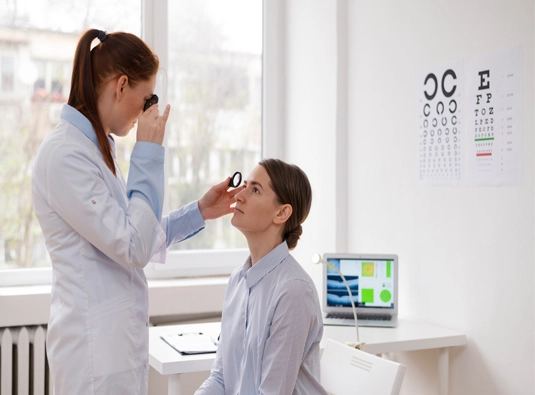
A full audiology assessment is combined with electroretinography and OCT imaging of the retina, adding vestibular balance testing wherever Type I looks likely. Pinning down the exact Usher type through genetic testing shapes both the prognosis discussion and which other family members might benefit from screening.
Meet The Team
Our Eye Specialists

Dr. Pawan
Associate Professor, Vitreo-Retina Surgeon. 10+ Years Experience
Retinal disorders, diabetic retinopathy, and advanced retina procedures. Provides diagnostic evaluation and treatment planning for international patients.

Dr.Pallavee
Senior Consultant Ophthalmologist & Eye Surgeon· 26+ yrs experience
Areas of Focus: Cataract surgery, corneal disorders, refractive procedures, and glaucoma management. Provides comprehensive eye care and surgical expertise for global patients.
Dr. Robin
Consultant Ophthalmologist & Eye Surgeon, MD, DO .16+ Years Experience
Areas of Focus: Cataract surgery, corneal disorders, refractive procedures, and glaucoma management. Provides comprehensive eye care and surgical expertise for global patients.
Treatment Approach in India
Retinal care follows the same principles used for other rod-cone dystrophies, with stem cell therapy weighed for patients whose results support it. Hearing care generally sits under a different specialty altogether — hearing aids, or evaluation for a cochlear implant where appropriate — so our retinal plan is built to work alongside whatever audiology support a patient already has in place in Rwanda, rather than replace it.
Reviews
What Our Patients Say

DR NAAGALAKSHMI R
2 months ago

Asha Babbar
2 months ago
The overall experience at the RP Treatment Center was very good. The staff was supportive and caring, and we provided proper attention and guidance during treatment. The environment at the center was clean and comfortable. The doctors and staff tried to understand patients' needs and explained the treatment process well.
Overall, I am satisfied with the service and care. Highly recommended!
Overall, I am satisfied with the service and care. Highly recommended!

Harshita Kapoor
2 months ago
Life‑Changing Experience with RP Therapy”
After years of struggling with vision loss due to Retinitis Pigmentosa, I finally found hope here. The doctors were highly professional, explained the stem cell treatment in detail, and gave me confidence at every step. The therapy was smooth, and I’ve already noticed positive changes in my daily life. Their dedication, care, and advanced medical approach make this center truly trustworthy
After years of struggling with vision loss due to Retinitis Pigmentosa, I finally found hope here. The doctors were highly professional, explained the stem cell treatment in detail, and gave me confidence at every step. The therapy was smooth, and I’ve already noticed positive changes in my daily life. Their dedication, care, and advanced medical approach make this center truly trustworthy

Yash Chauhan
2 months ago
I had a really good experience at RP Treatment Centre. The doctor listened to my problem patiently and explained the treatment in a simple way. The staff was polite and the clinic was clean. I started feeling better after the treatment. Highly recommended!

pragya chauhan
2 months ago
Very satisfied with the service. The doctor is experienced and gives proper attention to every patient. The staff is friendly, and the overall environment is comfortable. Thank you, RP Treatment Centre, for the excellent care.

Manisha kapoor
2 months ago
I had been struggling with Retinitis Pigmentosa for years, and finding this center was truly life‑changing. The doctors provided a thorough medical evaluation and explained every step of the stem cell therapy process with clarity. The treatment was smooth, professional, and I noticed encouraging improvements in my vision within weeks. Their continuous follow‑up care and compassionate support made me feel confident throughout the journey. Highly recommended for anyone seeking advanced RP treatment in India.
Frequently Asked Questions
Can you treat the hearing loss as well, or is it purely the eyes?
Our focus stays specifically on the retinal side of Usher Syndrome. Hearing care, including any cochlear implant evaluation, belongs to a separate specialty, and we shape our recommendations to complement whatever audiology support you already have or are arranging.
Our child was born with hearing loss — is it worth checking their vision as well?
Yes, particularly if Type I seems likely, since retinal symptoms in that type can begin appearing from later childhood onward. A baseline eye check early on makes any future change much easier to detect.
Does hearing loss from birth automatically mean Usher Syndrome?
No — congenital hearing loss has many possible causes, and Usher Syndrome accounts for only some of them. A retinal ERG combined with genetic testing gives the most reliable confirmation either way.
How is the type worked out, and does it change your approach?
Type is determined by the severity of hearing loss, whether balance is affected, and the age retinal symptoms began — usually confirmed with genetic testing. It mainly shapes how we discuss prognosis; the retinal evaluation itself stays broadly similar regardless of which of the three types is involved.