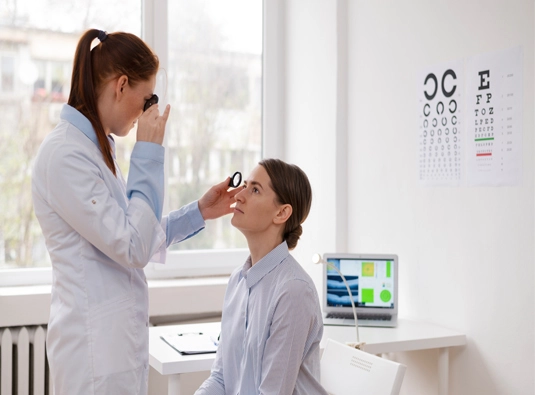
Retinitis pigmentosa (RP) is a group of inherited conditions in which the light-sensing cells of the retina slowly stop working. Most people first notice trouble seeing in dim light, and over the years the field of vision narrows from the sides, a change often described as looking through a tube. In India, RP is frequently recognised late, because difficulty after sunset is put down to “weak eyesight” or tiredness, and children are simply told to be careful in the dark.
This page explains the disease the way families in India usually meet it: what the first signs look like, what lies behind them, how the diagnosis is confirmed and what a structured evaluation involves, so that your next step is based on clear information.
10+
years Experience
years Experience
5000+
Patients treated
Patients treated
100+
Countries served
Countries served
NABH
Guided facility
Guided facility
Ocular Symptoms
Trouble seeing at dusk or in poorly lit rooms is usually the first sign. It is followed by bumping into furniture or people on the side, difficulty moving through crowded markets or unlit streets, and slow adjustment when stepping from bright sunlight into a dark room. With time, side vision narrows, colours may look duller and glare becomes uncomfortable. Central vision often stays usable for many years, which is why reading can remain possible even after getting around has become hard.
Underlying Causes
RP results from changes in genes that keep the retina’s rod cells, and later its cone cells, healthy. Dozens of genes have been linked to the condition, and it can pass through families in an autosomal recessive, autosomal dominant or X-linked pattern. In some families no earlier case is known at all. Where marriages take place within close family circles, the chance that a recessive form appears is higher, which is one reason family history is always taken carefully.
Diagnosis for Indian Patients
Evaluation starts with a detailed history and a dilated retinal examination, followed by visual field testing, OCT imaging of the macula and full-field electroretinography (ERG), which measures how rods and cones respond to light. Genetic testing is advised wherever possible, because it clarifies the inheritance pattern and helps relatives understand their own risk.
Meet The Team
Our Eye Specialists

Dr. Pawan
Associate Professor, Vitreo-Retina Surgeon. 10+ Years Experience
Retinal disorders, diabetic retinopathy, and advanced retina procedures. Provides diagnostic evaluation and treatment planning for international patients.

Dr.Pallavi
Senior Consultant Ophthalmologist & Eye Surgeon· 26+ yrs experience
Areas of Focus: Cataract surgery, corneal disorders, refractive procedures, and glaucoma management. Provides comprehensive eye care and surgical expertise for global patients.
Dr. Robin
Consultant Ophthalmologist & Eye Surgeon, MD, DO .16+ Years Experience
Areas of Focus: Cataract surgery, corneal disorders, refractive procedures, and glaucoma management. Provides comprehensive eye care and surgical expertise for global patients.
Treatment Approach in India
No single treatment cures RP today. The care plan therefore combines regular monitoring of progression, management of complications such as cataract and macular swelling, low-vision and mobility support, and an assessment of whether the patient is a suitable candidate for stem cell therapy. Goals are discussed openly so that families know what is realistic.
Reviews
What Our Patients Say

DR NAAGALAKSHMI R
2 months ago

Asha Babbar
2 months ago
The overall experience at the RP Treatment Center was very good. The staff was supportive and caring, and we provided proper attention and guidance during treatment. The environment at the center was clean and comfortable. The doctors and staff tried to understand patients' needs and explained the treatment process well.
Overall, I am satisfied with the service and care. Highly recommended!
Overall, I am satisfied with the service and care. Highly recommended!

Harshita Kapoor
2 months ago
Life‑Changing Experience with RP Therapy”
After years of struggling with vision loss due to Retinitis Pigmentosa, I finally found hope here. The doctors were highly professional, explained the stem cell treatment in detail, and gave me confidence at every step. The therapy was smooth, and I’ve already noticed positive changes in my daily life. Their dedication, care, and advanced medical approach make this center truly trustworthy
After years of struggling with vision loss due to Retinitis Pigmentosa, I finally found hope here. The doctors were highly professional, explained the stem cell treatment in detail, and gave me confidence at every step. The therapy was smooth, and I’ve already noticed positive changes in my daily life. Their dedication, care, and advanced medical approach make this center truly trustworthy

Yash Chauhan
2 months ago
I had a really good experience at RP Treatment Centre. The doctor listened to my problem patiently and explained the treatment in a simple way. The staff was polite and the clinic was clean. I started feeling better after the treatment. Highly recommended!

pragya chauhan
2 months ago
Very satisfied with the service. The doctor is experienced and gives proper attention to every patient. The staff is friendly, and the overall environment is comfortable. Thank you, RP Treatment Centre, for the excellent care.

Manisha kapoor
2 months ago
I had been struggling with Retinitis Pigmentosa for years, and finding this center was truly life‑changing. The doctors provided a thorough medical evaluation and explained every step of the stem cell therapy process with clarity. The treatment was smooth, professional, and I noticed encouraging improvements in my vision within weeks. Their continuous follow‑up care and compassionate support made me feel confident throughout the journey. Highly recommended for anyone seeking advanced RP treatment in India.
Frequently Asked Questions
Is night blindness always a sign of retinitis pigmentosa?
“No. Vitamin A deficiency and several other conditions can also reduce vision in dim light. An ERG and a retinal examination help tell them apart, which is why a proper test matters before drawing conclusions.”
Will a person with RP go completely blind?
”
The speed of progression varies widely between individuals and between gene types. Many people keep some useful vision for many years, but nobody can promise a fixed course, so regular monitoring is important.”
If I have RP, should my children be tested?
“That depends on how RP runs in your family. Genetic testing followed by counselling gives the clearest answer, and a baseline eye examination for children is sensible in any case.”
At what age does RP usually begin?
“Typical forms often show up in adolescence or young adulthood, although some begin in early childhood and others only later in life.”